Financial
Exposure, liquidity, return, and capital are continuously measured.
Implementation Risk Intelligence™
Organizations measure financial risk, operational risk, cybersecurity risk, and compliance risk. Yet the conditions that determine whether an initiative becomes sustained operational capability often remain invisible.
Deployment is an event. Operational capability is an organizational condition. The distance between them is implementation risk.

The familiar risk landscape
Mature organizations have developed systems for recognizing established forms of risk. Each has a vocabulary, a measurement practice, and an executive owner.
Exposure, liquidity, return, and capital are continuously measured.
Process failure, continuity, and capacity are made visible.
Threat, vulnerability, and response are monitored as conditions change.
Obligations, controls, and exceptions are governed through evidence.
The missing implementation layer
Organizations react to late projects, low utilization, and resistance because those outcomes are visible. Implementation risk develops beneath the surface—inside the organizational conditions that shape behavior, trust, workflow, and adaptation.
Above the surface
Below the surface
Why AI exposed the gap
AI can be deployed faster than organizations can align leadership, redesign workflows, build trust, develop ability, and learn. The technology moves at software speed. Operational capability develops at organizational speed.
Access, licenses, and tools can be provisioned in days.
Trust, workflow, behavior, governance, and learning develop over time.
A new discipline
Implementation Risk Intelligence™ is the discipline of recognizing, measuring, interpreting, and managing the organizational conditions that influence whether strategic initiatives become sustained operational capability.
Make familiar patterns legible.
Establish evidence across conditions.
Understand relationships and implications.
Guide proportionate organizational action.
Recognition through patterns
Profiles are not judgments or maturity scores. They are recognition tools—ways to identify the pattern an organization is currently experiencing so that measurement begins with context.
Interest is high, but ownership, priorities, and operating boundaries are still forming.
Tools have been introduced, yet use remains uneven and operational integration has slowed.
Executive direction is clear, but employee trust, autonomy, and workflow participation remain uneven.
Experiments multiply across teams without a shared language, governance layer, or learning system.
Alignment and capacity are present, creating the conditions for disciplined measurement and sustained adaptation.
After the pattern becomes recognizable, a profile can help locate the conditions worth examining more closely.
Find your implementation profileResearch and category resources
Research, frameworks, field observations, and executive briefs make the language of implementation risk more precise—and help leaders recognize conditions before outcomes harden.
An introduction to the organizational conditions that shape whether strategic initiatives become operational capability.
Begin with the category →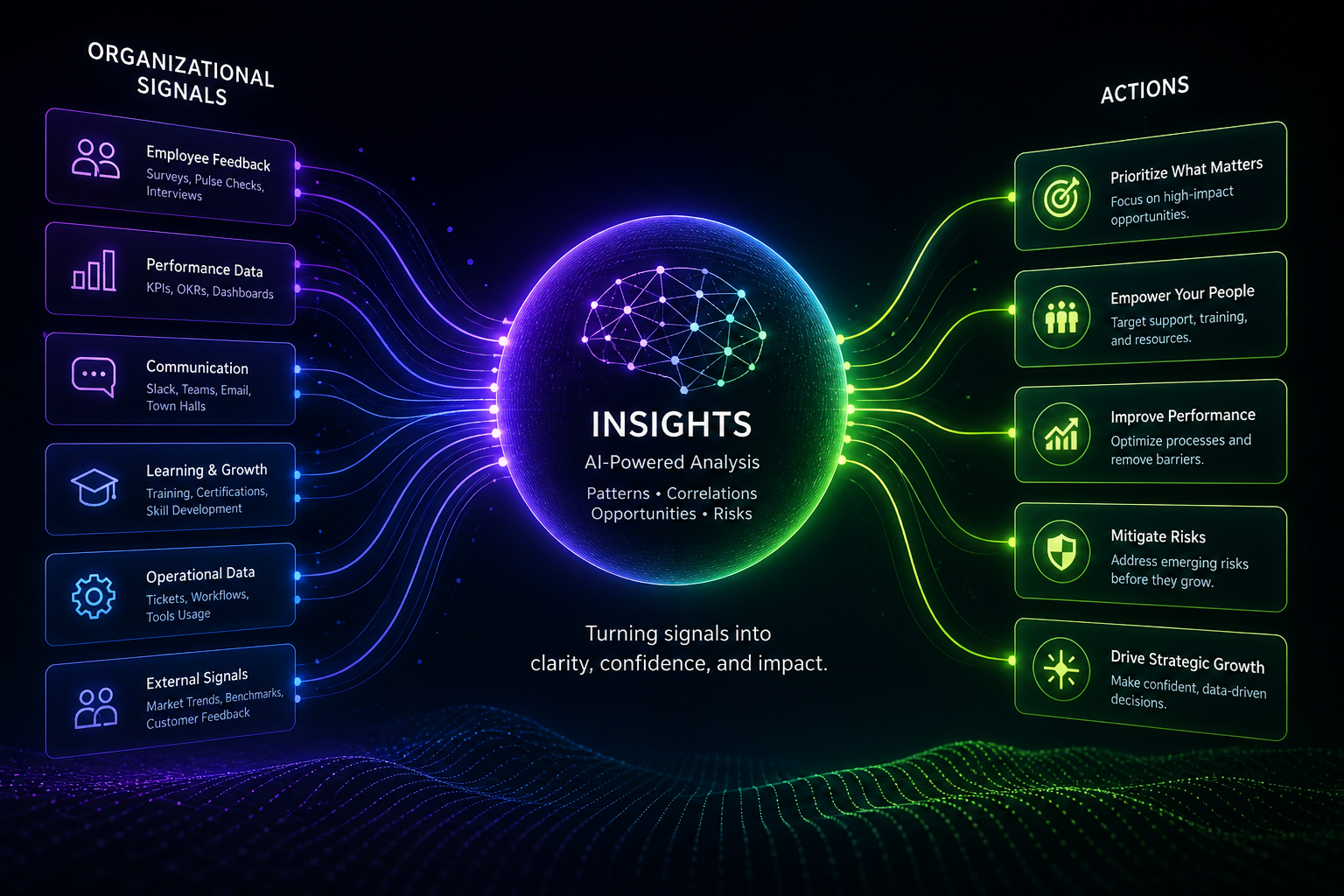
Definitions for the signals, conditions, and distinctions that make the category understandable.
Explore the glossary →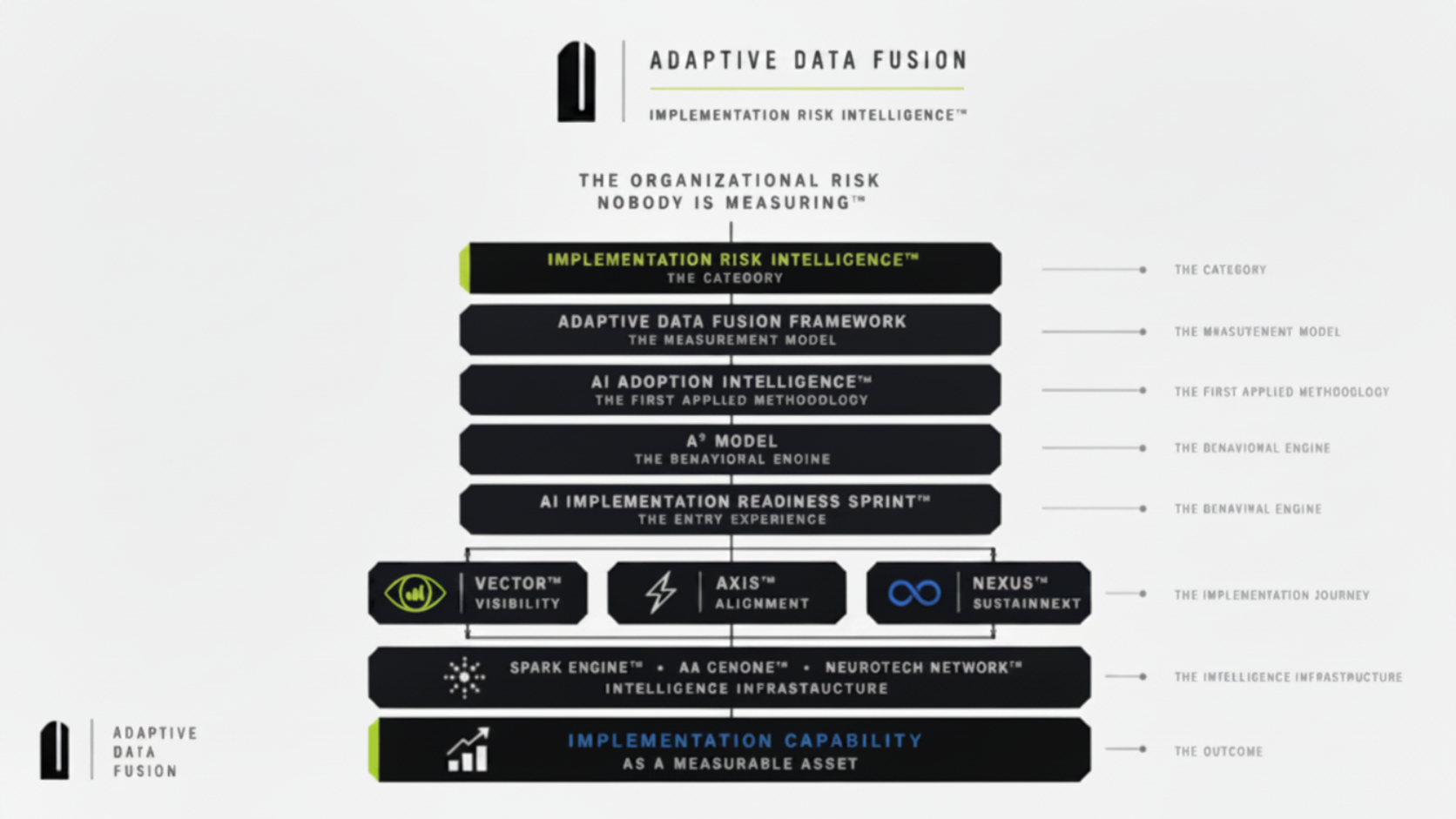
An evolving research index connecting peer-reviewed scholarship, field observation, and category interpretation.
Examine the evidence →The emerging vocabulary
These terms establish a common language for observing implementation without reducing it to a deployment milestone or a single adoption score.
The exposure created when the organizational conditions required for an initiative to become sustained operational capability are unknown, misaligned, or changing.
The discipline of recognizing, measuring, interpreting, and managing the organizational conditions that influence implementation outcomes.
The leadership, readiness, workflow, behavioral, governance, trust, and learning factors that shape how an initiative is understood and used in practice.
The sustained ability of an organization to use a strategic initiative reliably within real work, decisions, roles, and routines.
Visible outcomes are the symptoms leaders can observe. Hidden conditions are the underlying organizational factors that help explain how those outcomes formed.
Continue the recognition journey
Continue through research and field observations, or use the implementation profile to locate the pattern your organization may be experiencing.
Implementation Risk Notes
Category definitions, research notes, executive briefs, and field observations—delivered as the discipline develops.
By subscribing, you agree to receive educational updates from Adaptive Data Fusion. Unsubscribe at any time.
Implementation profile
The assessment offers a contextual profile—not a grade—and identifies the organizational signals associated with that pattern.
A business email is required within the assessment to receive your result.